
Fortec UK Unveils AAEON GENE-ARH6 AI SubCompact Board
Buyer News | 16-12-2025 | By Jack Pollard
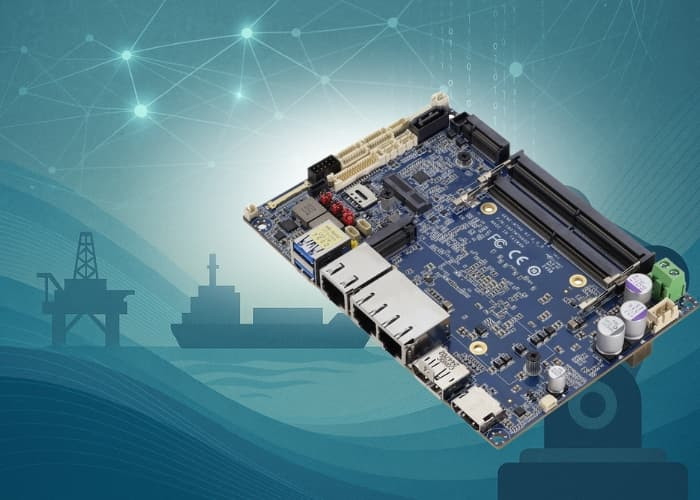
Key Things to Know:
- Fortec UK has introduced AAEON’s GENE-ARH6 SubCompact Board for AI-driven industrial, maritime and offshore applications.
- The platform is built on Intel® Core™ Ultra processors with GPU and NPU acceleration, delivering up to 96 TOPs for edge AI inference.
- An industrial-focused design with wide power input and legacy I/O support makes it suitable for harsh and long-life environments.
- Advanced display and vision capabilities support real-time monitoring, safety systems and industrial HMI deployments.
Across industrial, maritime and offshore sectors, system designers are increasingly being asked to deliver higher levels of intelligence at the edge, without compromising reliability or space efficiency. Compact embedded platforms now sit at the centre of applications ranging from industrial automation and condition monitoring to safety critical vision systems, where AI performance, thermal stability and long term availability are equally important. As operational environments become more demanding, the need for embedded boards that can support advanced workloads while remaining resilient in harsh conditions continues to grow.
Fortec UK operates within this landscape as a specialist supplier of embedded computing, display technologies and power solutions for demanding applications. Working closely with OEMs, system integrators and design engineers, Fortec UK supports the selection and deployment of platforms that must perform reliably across extended lifecycles, often in environments where failure or downtime is not an option.
Within this context, Fortec UK has introduced the AAEON GENE-ARH6 SubCompact Board, a platform designed to address the evolving requirements of AI enabled industrial systems. Rather than targeting general purpose computing, the GENE-ARH6 is engineered to serve as a high performance embedded core, capable of supporting inference driven workloads, real time analytics and advanced visual processing at the edge.
By combining next generation Intel processing with an industrial focused design philosophy, the GENE-ARH6 delivers the AI performance and system robustness required for maritime and offshore environments. Its architecture is intended to support applications where environmental resilience, flexible I/O and sustained compute capability are essential, positioning the board as a foundation for next generation industrial platforms rather than a conventional single board computer.
AI-Centric Processing Built on Intel Core Ultra Architecture
At the heart of the GENE-ARH6 SubCompact Board is a processing architecture designed specifically to support modern AI workloads at the edge. Built around Intel® Core™ Ultra 200H and 200U Series processors, the platform delivers a balance of high performance compute, graphics acceleration and dedicated AI processing that is well suited to industrial environments where real time decision making and low latency inference are critical.
Rather than relying on a single processing engine, the GENE-ARH6 adopts a heterogeneous acceleration approach. Compute tasks are distributed across multiple specialised engines, enabling more efficient handling of AI inference, data processing and visual workloads. This architecture combines the general purpose CPU with the Intel® Arc™ 140T GPU for graphics and parallel processing, alongside the Intel® AI Boost NPU, which is dedicated to accelerating AI inference tasks.
The inclusion of the Intel Arc 140T GPU allows the GENE-ARH6 to handle graphics intensive workloads and real time visual analytics, making it suitable for applications such as multi camera vision systems and high resolution HMI displays. In parallel, the Intel AI Boost NPU offloads neural network inference from the CPU, improving overall system efficiency while reducing power consumption and thermal load, both of which are key considerations in enclosed or rugged industrial installations.
Together, these processing elements enable up to 96 TOPs of AI performance. In practical industrial terms, this translates into the ability to run complex inference models locally, without relying on cloud connectivity. Tasks such as object detection, anomaly recognition and predictive analysis can be performed in real time, supporting faster response times and improved system autonomy in environments where connectivity may be limited or unreliable.
This level of AI capability makes the GENE-ARH6 well suited to a range of edge applications. In industrial robotics, it can support advanced motion control and machine vision. For vision based inspection, the platform enables real time defect detection and quality assurance. In safety monitoring systems, inference driven analytics can be used to identify hazards, trigger alerts or initiate automated responses, helping to protect both personnel and equipment.
For industrial and maritime deployments, this processing architecture is particularly valuable. By bringing AI inference to the edge, the GENE-ARH6 reduces dependence on centralised computing resources, lowers latency and enhances system resilience. This allows designers to deploy intelligent systems that remain responsive and reliable, even in challenging operational environments.
Industrial-Grade Design for Maritime and Offshore Environments
Beyond raw processing capability, the GENE-ARH6 SubCompact Board is defined by an industrial design philosophy that prioritises reliability, flexibility and long term system integration. In maritime and offshore environments, embedded platforms must operate consistently despite exposure to electrical noise, variable power conditions and extended deployment cycles. The GENE-ARH6 is engineered with these challenges in mind, making it suitable for use in mission critical industrial systems.
A key aspect of this design is support for a wide 9V to 36V power input range. This capability allows the board to operate reliably in environments where power sources may be unstable, distributed or subject to fluctuation, such as vessels, offshore platforms or remote industrial installations. By tolerating a broader voltage range, the system reduces the need for additional power conditioning and improves overall resilience.
Connectivity and system integration are equally central to the platform’s industrial focus. The GENE-ARH6 provides a comprehensive set of industrial I/O options to support both modern and legacy equipment. This includes support for RS-232/422/485 alongside standard RS-232, enabling communication with a wide range of existing industrial devices, controllers and sensors that remain in active service across many sectors.
Additional expansion and control are supported through multiple COM headers, an 8-bit GPIO interface and options for SMBus or I2C connectivity. These interfaces allow system designers to integrate custom peripherals, manage low level device communication and bridge newer AI-enabled systems with established control architectures. This flexibility is particularly important in environments where upgrades must coexist with long standing infrastructure rather than replace it.
Together, these design considerations make the GENE-ARH6 well suited to long life platforms and applications where reliability cannot be compromised. Whether deployed in offshore monitoring systems, maritime control equipment or industrial automation environments, the board supports stable operation, extended lifecycle planning and dependable integration into complex, mixed generation systems.
High-Resolution Display and Vision Support for Industrial HMI and Monitoring
As AI becomes more deeply integrated into industrial systems, display and vision capabilities play an increasingly important role in how data is interpreted, presented and acted upon. The GENE-ARH6 SubCompact Board is designed to support advanced visual workflows, enabling real time monitoring, analytics and operator interaction across a wide range of industrial applications.
The platform supports peripheral camera integration through multiple USB and Ethernet interfaces, allowing designers to deploy multi camera configurations for vision based inspection, situational awareness and safety monitoring. This flexibility is essential for AI driven systems that rely on continuous visual input to analyse environments, detect anomalies or track activity in real time.
For display output, the GENE-ARH6 offers HDMI 2.1 and DisplayPort 2.0 connectivity, enabling ultra high resolution output up to 8K. This level of visual performance supports detailed data visualisation, high fidelity video streams and complex graphical overlays, making it suitable for control room displays, monitoring stations and advanced operator interfaces.
In addition to external displays, the board also supports dual-channel LVDS and eDP 1.4b interfaces for embedded human machine interfaces and system dashboards. These options allow seamless integration with panel mounted displays commonly used in industrial equipment, providing clear and responsive visual feedback directly at the point of operation.
Underpinning these capabilities is the integrated Intel® Arc™ GPU, which enables real time visual processing and analytics alongside AI inference. By accelerating graphics and parallel workloads, the GPU supports smooth rendering, rapid image analysis and responsive user interfaces, even when processing high resolution video streams.
These combined capabilities make the GENE-ARH6 well suited to environments where clear visualisation and rapid decision making are critical. From maritime control rooms and offshore safety systems to industrial operator consoles, the platform provides the visual performance and flexibility required to support modern, AI enabled monitoring and control solutions.
Fortec UK and the Role of Embedded AI Platforms
The introduction of the AAEON GENE-ARH6 SubCompact Board reflects a broader shift in how industrial and maritime systems are being designed. As AI driven functionality becomes a core requirement rather than an optional enhancement, embedded platforms must deliver a combination of performance, resilience and long term reliability. The GENE-ARH6 sits firmly within this space, providing a compact yet powerful foundation for edge AI deployments in challenging operational environments.
By bringing together heterogeneous AI acceleration, industrial grade power support and flexible I/O, the GENE-ARH6 addresses the practical realities of modern system design. It enables engineers to deploy intelligent capabilities directly at the edge, supporting real time analytics, visual processing and autonomous decision making without compromising system stability or lifecycle planning.
Fortec UK’s role in delivering this platform extends beyond the supply of hardware. As a technology partner, the company works closely with customers to understand application requirements, environmental constraints and long term support needs. This consultative approach helps ensure that embedded platforms such as the GENE-ARH6 are selected, integrated and supported in a way that aligns with both immediate project goals and future scalability.
The GENE-ARH6 also complements Fortec UK’s wider portfolio of embedded systems, displays and power solutions, allowing customers to build cohesive platforms that address compute, visualisation and system integration requirements together. This alignment is particularly valuable in industrial and maritime sectors, where system reliability and supplier continuity are critical considerations.
As AI continues to reshape industrial operations, SubCompact boards with dedicated acceleration and industrial resilience are becoming key enablers of next generation deployments. Platforms like the GENE-ARH6 demonstrate how compact embedded solutions can support increasingly complex workloads, helping organisations move towards more intelligent, responsive and autonomous systems. Further information on the GENE-ARH6 is available via Fortec UK.